Introducing CADENCE: Forecasting the cash flows behind business credit decisions

Imagine two businesses each received $20,000 last month. One was paid by a customer that orders regularly. The other received a one-time deposit. Their total inflows are identical, but the evidence those deposits provide about future repayment capacity is very different.
Now consider the obligations those businesses must meet: payroll next Friday, rent at the start of the month, loan payments every week. Underwriting depends on understanding how much of that revenue will continue, which obligations will persist, and when money is likely to arrive relative to when it leaves.
Recurring cash flows are the backbone of that assessment. For small businesses, they are also particularly difficult to estimate.
Today, we’re sharing CADENCE, our new research on identifying and forecasting recurring business payments. It addresses a central challenge in cash-flow underwriting: turning a limited, often ambiguous transaction history into a reliable view of ongoing revenue and obligations.
Why recurrence is hard to recognize
Business deposits include customer receipts, financing proceeds, owner contributions and transfers between accounts. Their descriptions often reveal little about their purpose. A monthly ACH transfer could represent an ongoing service relationship, a loan installment or a transfer between related entities. Its rhythm, amounts and persistence provide evidence that the descriptor alone cannot.
That history is often short. After only three or four payments, an underwriter may already need to assess a new customer relationship or financing obligation.
The stakes run in both directions. Missing new recurring revenue can understate repayment capacity. Continuing to count revenue that has stopped can overstate it. These errors flow through underwriting, affecting revenue estimates, risk scores and credit limits.
Where our current method falls short
Slope’s existing recurrence estimator uses a fast Fourier transform, or FFT, to identify dominant payment intervals. It is transparent, inexpensive and effective on long, regular histories. But it needs several payment cycles to establish a pattern, making new revenue streams and obligations harder to recognize. It also cannot use counterparty information to help interpret a short history.
Calendar schedules create another difficulty. A payment on the second Wednesday of each month arrives either four or five weeks after the previous one; a weekend can shift a monthly payment to Monday. FFT can interpret these shifts as irregularity. It also summarizes past patterns without directly estimating whether the next payment will occur or how certain its timing is—information underwriting needs when relationships start, stop or change.
How CADENCE solves the problem
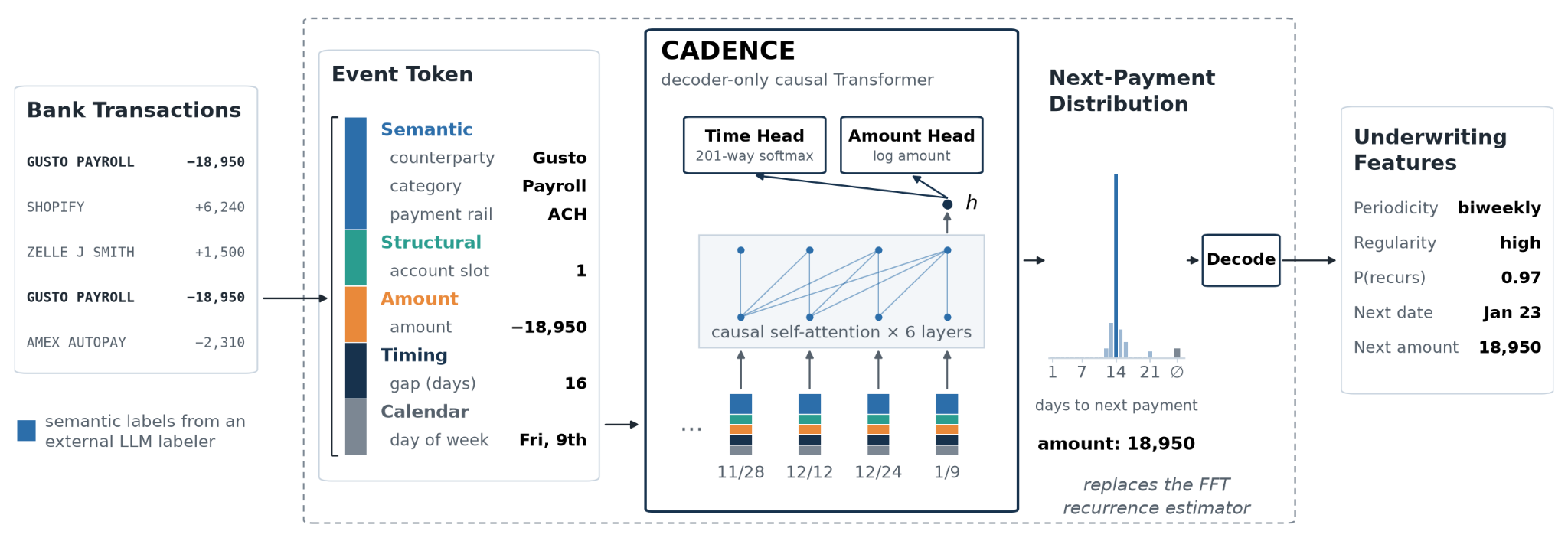
CADENCE treats transactions as tokens and uses a compact Transformer to learn how each counterparty’s payment stream behaves over time. It combines payment history with counterparty information and calendar context to forecast the next payment.
Counterparty information provides useful context when only a few payments are available. Calendar inputs help the model recognize schedules such as monthly payments and recurring weekdays. Training also includes examples of streams that stop, so the model learns when a pattern may no longer continue.
For each stream, CADENCE estimates the next payment’s amount and predicts a probability distribution over its timing, including the possibility that no payment occurs within the forecast horizon.
Forecast confidence for credit decisions
Suppose a customer usually pays near the beginning of the month. A forecast concentrated around a few days provides a different basis for underwriting than one spread across several weeks.
CADENCE makes that distinction explicit. Its predictions can cluster around one date, show several plausible dates, or remain uncertain when the history does not support a precise forecast.
In one example from the paper, a payment normally posted on the second day of the month. When that date fell on a Saturday, the model’s strongest prediction was the following Monday—the day the payment arrived.
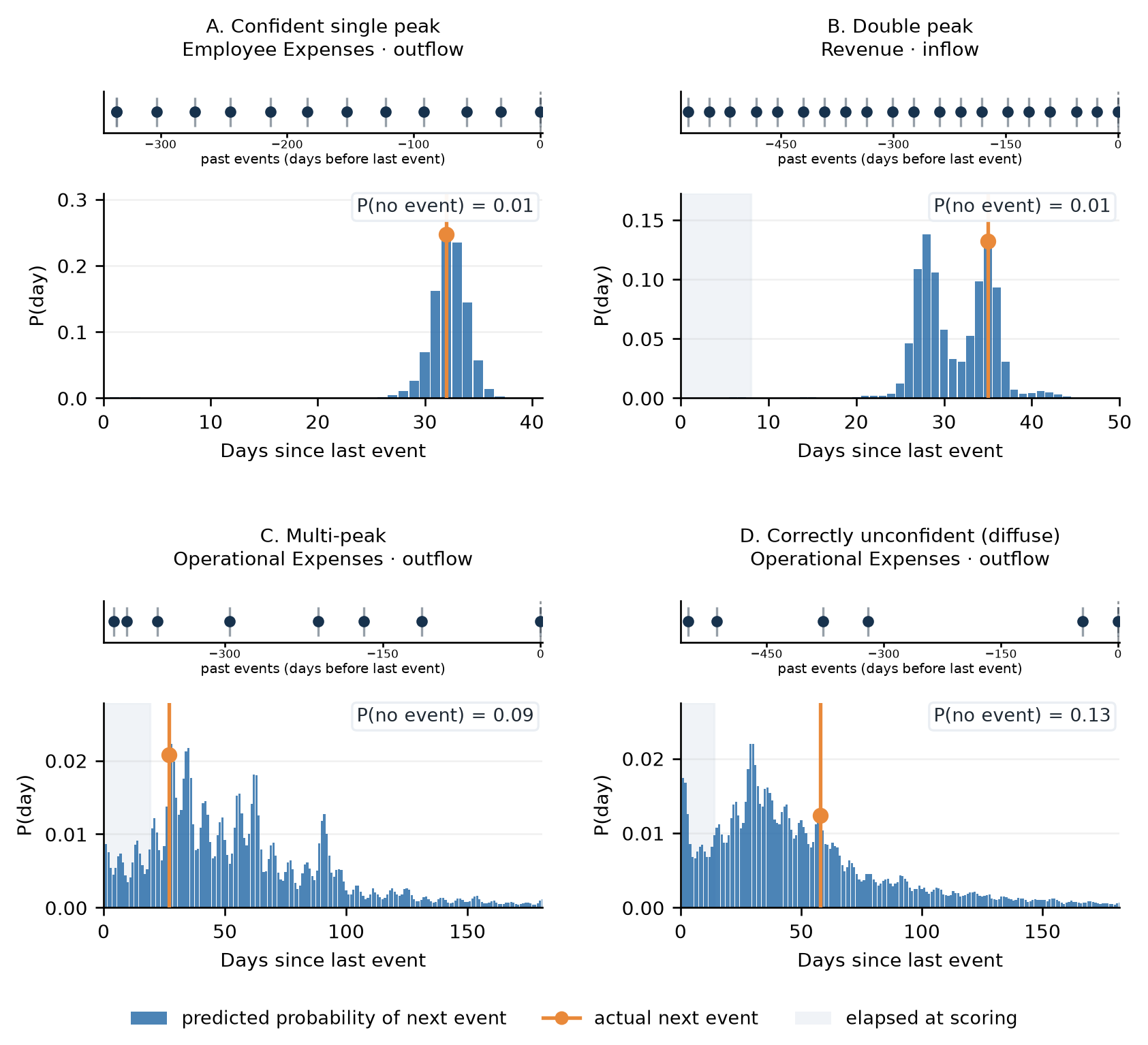
The forecast can also change as time passes without a payment. If an expected receipt has not arrived, the system can update its assessment using that absence as evidence.
For lenders, this creates a basis for deciding which recurring flows to include and how confidently to rely on their timing. It also supports potential monitoring applications: an expected revenue deposit that fails to arrive can prompt review, with the forecast’s uncertainty informing when that review is warranted.
What this means for credit decisions
We evaluated CADENCE using roughly 47 million business bank transactions, comparing its forecasts with Slope’s existing recurrence estimator.
Accuracy within one day of the next payment improved by 93.3% relative to the baseline. The paper also examines how calendar information, counterparty context and examples of stopped streams contribute to forecasting performance.
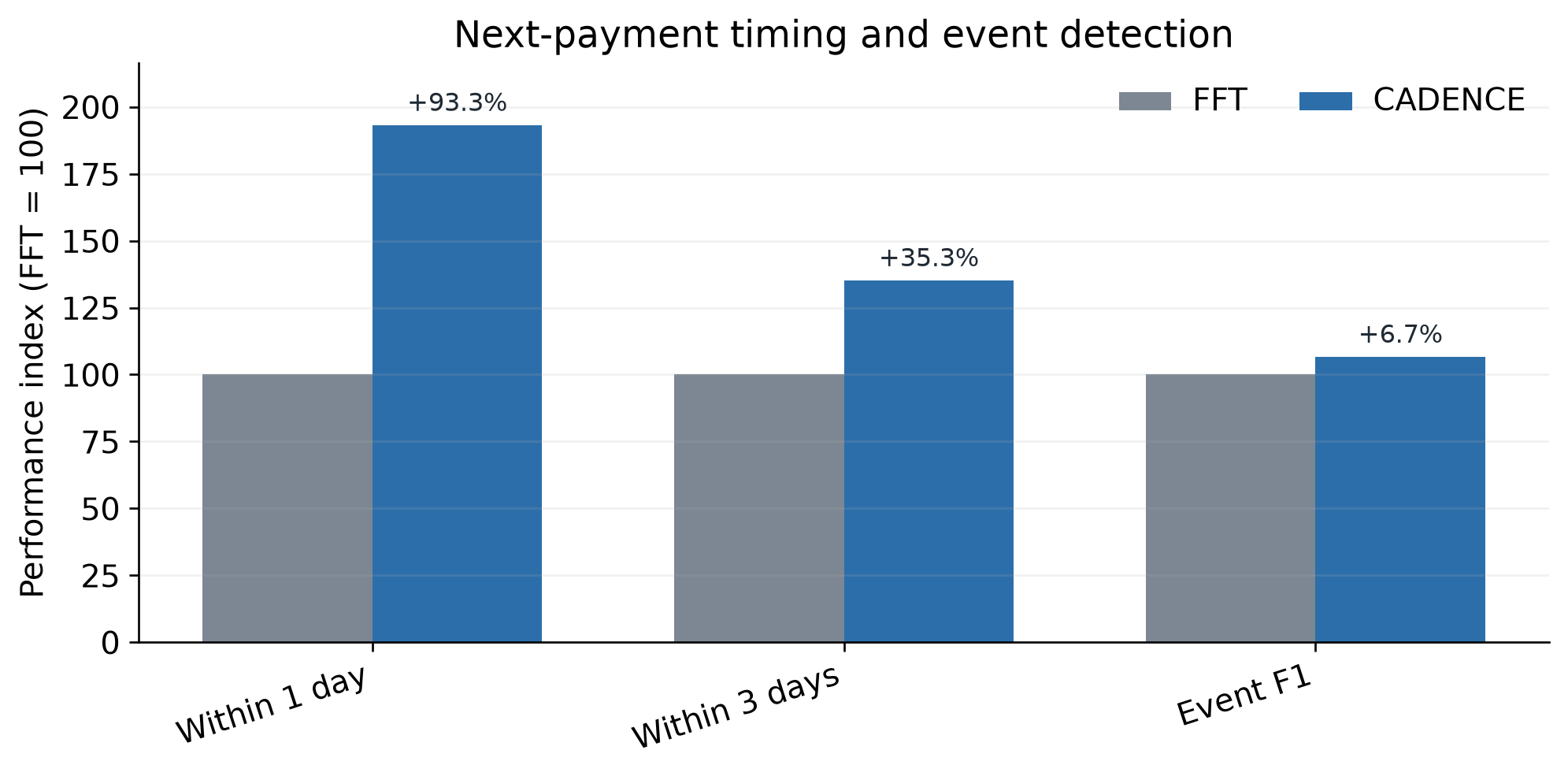
The result we’re most excited about is the downstream credit evaluation.
Replacing our existing recurrence features with CADENCE’s increased the approval rate by 18.2% at the same loss rate, a relative improvement over our production baseline. Other underwriting input features were held fixed, and credit models were retrained and evaluated across separate groups of customers.
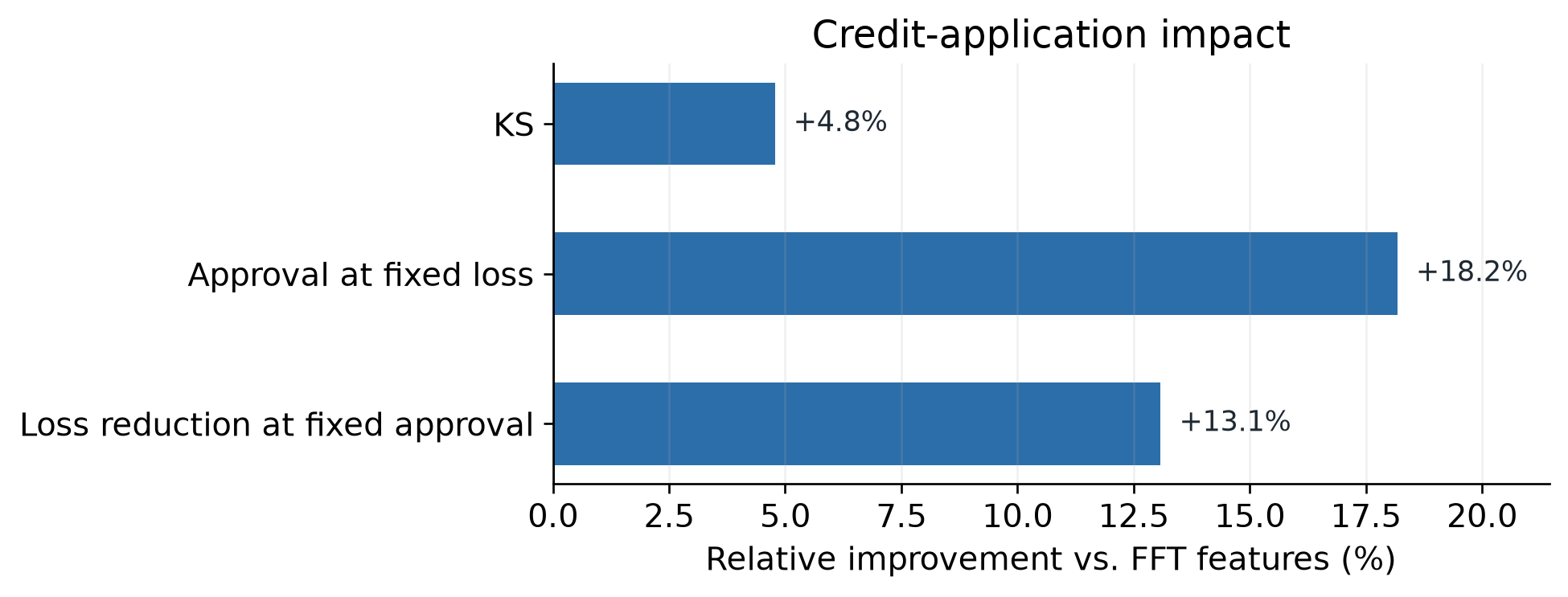
These historical results show that more accurate recurrence estimates can add useful information to an existing credit model. They also reinforce why the underlying problem matters: how we interpret individual payment relationships can materially affect our assessment of a business’s ability to repay.
For the businesses in the opening example, that means giving an ongoing customer relationship appropriate weight, recognizing the obligations that revenue must support, and keeping those estimates current as the business changes.
Read the full CADENCE paper by Alexander Wu and Jingchao Huang.
Evaluation note: Results are historical and specific to Slope’s data. Reported improvements are relative to the FFT baseline; the timing metric covers streams with both a forecast and an observed next payment. Prospective evaluation is needed to assess sustained lending impact.