

Amazon Account Level Reserve and Reserve Hold: What Sellers Need to Know
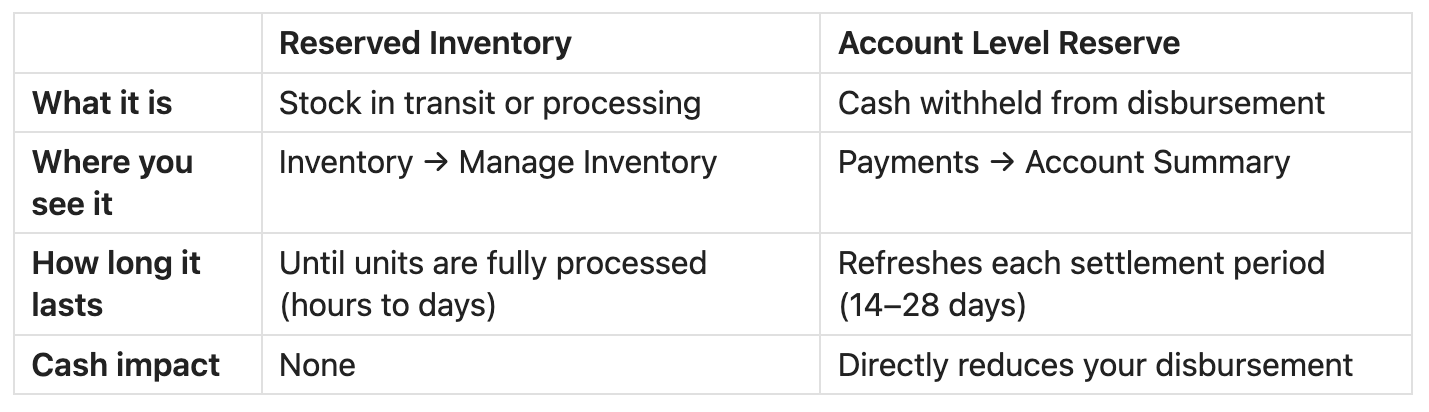
Amazon's account level reserve is cash withheld from your disbursement as a buffer against expected returns and claims. It's different from reserved inventory, which is a fulfillment status with no cash impact. Only one of them affects your bank account.
The Two Types of "Reserve" on Amazon and Why They're Different
When you see the word "reserved" in Seller Central, you're probably looking at one of two different things. Sellers confuse them constantly, partly because Amazon uses similar language for both.
Reserved inventory is a fulfillment status. It reflects units in transit between warehouses, being processed for a customer order, or under review. It has no cash impact because it's a count of stock that isn't available for new orders yet.
Account level reserve is a cash hold. Amazon withholds a portion of your settlement funds as protection against future returns, A-to-Z claims, and chargebacks. It reduces the dollar amount you actually receive each disbursement cycle.
You may also see "reserve hold" used in seller forums and Amazon support threads. It refers to the same concept of cash held back before your funds are released.
How Amazon Calculates the Account Level Reserve
Amazon estimates how much you're likely to owe in returns and claims over the next few weeks. That estimate becomes your reserve.
The calculation draws on your trailing sales history and return rate, typically a 14–28 day window. Amazon doesn't publish the exact formula, and you won't receive an itemized breakdown. What you will see is that your reserve scales directly with your revenue. Higher sales volume means a larger reserve.
Category return rates typically fall between 5% and 15%. In practice:
- At $50,000/month in sales: roughly $3,000–$7,000 in reserve at any time.
- At $200,000/month: approximately $12,000–$28,000.
A growing reserve is a sign of a growing business.
How DD+7 Changes the Reserve Equation
On March 12, 2026, Amazon introduced its DD+7 policy. It adds 7 days to fund release, measured from the confirmed delivery date of each order, not the ship date.
DD+7 operates alongside the account level reserve, not instead of it. The two stack. Sellers with strong sales volume may see a larger share of their earnings held during peak periods than before the policy change.
The key is to plan for it. If you know your average daily sales and your typical reserve window, you can forecast your cash position accurately. For a full breakdown of how DD+7 works — and a timeline of what happens to your money from sale to bank — see our post on Amazon's new DD+7 policy.
How to Estimate Your Account Level Reserve
Amazon doesn't provide a reserve calculator, but you can build a reliable working estimate in three steps:
- Find your average daily sales over the past 30 days.
- Multiply by your estimated return rate (5–15%, depending on category).
- Multiply by 14–28 (the typical reserve window in days).
Example: $2,000/day × 8% return rate × 21 days ≈ $3,360 in reserve.
Your actual reserve will vary based on claims history, account health, and Amazon's internal risk model. Treat this as a planning number, not a guarantee. Once you know your approximate reserve range, you can build it into your cash flow projections and stop being surprised by disbursement shortfalls.
Where to Find Your Reserve Balance in Seller Central
Your account level reserve appears under Payments → Account Summary. Look for the "Account Level Reserve" line item in the balance breakdown.
The number updates at the close of each settlement cycle. If your reserve has increased between disbursements, it typically means your sales volume grew, not that something is wrong with your account.
For a transaction-level view, go to Payments → Transaction View. Each reserve adjustment is logged there with a date, so you can see exactly when changes were applied.
What to Do When the Reserve Affects Your Working Capital
The account level reserve is a permanent feature of selling on Amazon. It doesn't disappear, and it grows in line with your business. For sellers scaling up (adding SKUs, building inventory depth, or ramping into peak season) that means more cash tied up in Amazon's system precisely when you need it most.
Sellers who plan around this tend to maintain a working capital buffer that covers at least one full reserve cycle. Others use external financing to keep supplier and inventory payments on track without waiting for disbursements to clear.
Slope's Amazon Line of Credit
For Amazon sellers who receive an offer through Seller Central, Slope's revolving line of credit* is available directly in the Amazon Lending portal. Revolving lines up to $5M, APRs as low as 8.99%, subject to credit approval and eligibility requirements. Supported by a J.P. Morgan credit facility, originated by Lead Bank, Member FDIC.
Each draw carries a fixed repayment schedule you set at the time of the draw — repayment does not accelerate based on revenue volume. As draws are repaid, the line replenishes for the next inventory cycle. The application uses a soft credit pull and does not affect your personal credit score. No personal guaranty required.
Check your eligibility in the Amazon Lending portal in Seller Central.
*Slope is a financial technology company, not a bank. Business-purpose loans made by Lead Bank and subject to credit approval. Application and consent to obtain personal credit report is required. Subject to minimum revenue and business requirements. Fees vary based on risk assessment and loan term.
FAQ
What is the Amazon account level reserve?
It's cash Amazon withholds from your disbursement as a buffer against estimated future returns, A-to-Z claims, and chargebacks. The amount is based on your recent sales history and return rate.
Is "reserved inventory" the same as "account level reserve"?
No. Reserved inventory is a stock status — units in transit or under processing. Account level reserve is a cash hold that reduces your disbursement. They appear in different parts of Seller Central and have nothing to do with each other.
What is a "reserve hold" on Amazon?
"Reserve hold" is a term sellers and Amazon support teams sometimes use interchangeably with account level reserve. It refers to cash withheld from your disbursement — not to inventory status.
Why does Amazon hold money in reserve?
Amazon uses the reserve to cover refunds and claims it expects to receive in the coming weeks. It's a standard risk management practice — not a penalty or a sign of account trouble.
How long does Amazon keep my money in reserve?
The reserve runs on a rolling 14–28 day cycle tied to your settlement period. Funds move through the reserve continuously. Nothing is locked indefinitely.
How much does Amazon typically hold in the account level reserve?
It depends on your sales volume and return rate. Rough estimates: $3,000–$7,000 at $50K/month in sales; $12,000–$28,000 at $200K/month.
How does DD+7 affect the account level reserve?
DD+7 adds 7 days to when funds are released after delivery. It operates alongside the account level reserve — the two stack. See our post on Amazon's new DD+7 policy for a full timeline.
This content is for informational purposes only and does not constitute financial, legal, or tax advice. Slope financing products are available for business purposes only and are subject to credit approval and underwriting review.