

How to Finance an Amazon Product Launch Without Running Out of Cash
An Amazon product launch requires capital across three separate events: the initial inventory order, elevated PPC spend during the listing's honeymoon period, and a second inventory order that must be funded before launch revenue has cleared Amazon's disbursement cycle. Most sellers budget for the first event only. A complete launch, from supplier deposit to rank stability, typically requires 5–6 months of active capital deployment before the launch fully pays for itself.
The Three Capital Events in a Product Launch
Most launch budgets account for the inventory order and stop there. The structure is actually three distinct events, each with its own timing and capital requirement.
Capital Event 1: Initial Inventory Order
The first order carries complications beyond a normal restock. Minimum order quantities force you to buy more than you'd ideally start with, typically 3–6 months of projected sell-through, without any velocity data to validate the estimate. The cost has several components:
- COGS × MOQ: The inventory itself at landed unit cost
- Ocean freight: ~$2,000–$4,000 per 40-foot container from China to U.S. West Coast
- Customs duties: Varies significantly by product category, HTS code, and country of origin. Verify your specific duty rate with a customs broker before finalizing unit economics.
- FBA prep: $0.50–$1.50 per unit for FNSKU labeling, polybagging, bundling
- FBA inbound shipping: $0.30–$1.00 per unit from domestic warehouse to fulfillment center
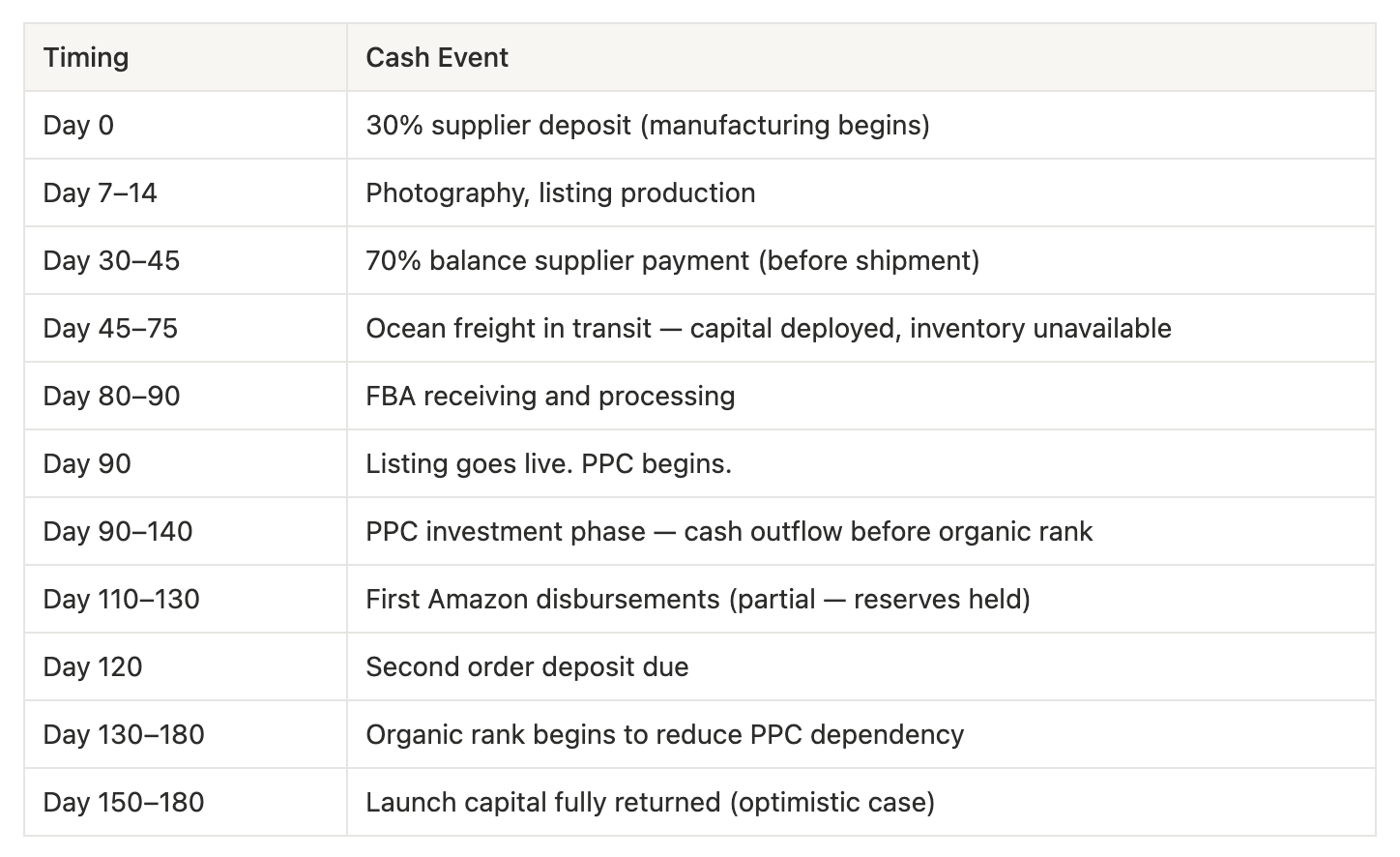
Payment timing: 30% supplier deposit at Day 0 when production begins, 70% balance due before shipment at Day 30–45. That capital is deployed on Day 0 and doesn't return as cash until sell-through plus Amazon's disbursement cycle — Day 110–130 at the earliest.
Capital Event 2: Honeymoon Period PPC
Amazon algorithmically boosts new listings during the first 30–60 days after launch. Sellers who run aggressive PPC during this window extract maximum visibility from that boost. Sellers who underfund PPC during this period don't get a second chance at the same algorithmic lift.
The budget range is wide: $1,000–$2,000/month for lower-competition niches, $2,000–$8,000/month for competitive categories. The key constraint: this spend is entirely pre-revenue. No organic rank exists yet, and there haven’t been any meaningful disbursements from initial sales. Every ad dollar during the honeymoon period comes from capital deployed ahead of any return.
The PPC cost from launch to organic rank stability (typically 3–4 months) can reach $15,000–$30,000 or more in competitive categories. Budget for this duration before modeling any reduction in spend.
Capital Event 3: Second Inventory Order
The reorder trigger typically arrives around Day 105–120, when the first batch has enough remaining sell-through to maintain rank but not so much remaining stock that reordering can wait.
The problem is that the deposit on batch 2 is due while batch 1 revenue is still locked in Amazon's disbursement cycle. Amazon's reserve hold and 14-day disbursement cycle mean batch 1 cash often isn't fully available until Day 110–130. Sellers who plan to fund the second order from launch revenue often find the timing doesn't work.
This is the capital event most launch budgets omit. Sellers who encounter it unprepared fund the second order from operating cash, draining the working capital buffer at exactly the moment launch PPC is still running.
The Launch Capital Timeline
The cash needs come in waves, which matters for how you structure the capital going in.
A launch needs capital available across a 5–6 month window. Unlike a restock, where capital deploys, inventory sells, capital returns, a launch has overlapping demands. PPC capital is still going out while inventory capital from batch 1 is locked in Amazon's cycle, and the second-order deposit is due before either has fully returned. Here’s an example of what that might look like:
Why Underfunding a Launch Costs More Than the Shortage
The math on a well-funded vs. underfunded launch isn't linear. The costs of running short compound through three mechanisms.
Cutting PPC before rank establishes costs more than the PPC itself. Amazon's algorithm rewards consistent velocity. An ASIN that shows 90 days of strong conversion followed by a gap because the seller ran out of ad budget doesn't pause at its current rank. Rank decays, sometimes substantially, during any extended velocity drop. Recovering rank after decay requires another round of aggressive PPC investment that often costs more than staying funded through the initial rank-build would have.
Running out of stock during rank-building resets the launch. A stockout during the rank-building phase can drop an ASIN from page 2 to page 20 overnight. Sellers who stockout 8 weeks into a launch and wait 6 weeks for new inventory often find they're starting from scratch, not resuming where they left off.
Launching with insufficient review velocity. Conversion rate is suppressed below 15–20 reviews on most ASINs. Sellers who cut their launch budget before review count reaches this threshold find their cost per acquisition for reviews is higher because conversion rate is lower, which means launch PPC spend is less efficient for longer.
The capital deployed into a launch funds a duration of sufficient momentum. Cutting that duration short often increases the total cost.
How to Calculate Your Launch Capital Requirement
Run the numbers before placing the supplier order. The framework:
Initial inventory capital:
(Unit COGS + freight/customs per unit + prep costs per unit) × Initial order quantity
PPC launch budget:
Estimated monthly PPC spend × months until organic rank stability(Conservative: 4 months at $3,000/month = $12,000 for a competitive category)
Listing and photography:
One-time, typically $1,000–$4,000
Promotional and launch costs:
Estimated cost of velocity programs and initial pricing discounts
Second-order deposit:
30% of projected second batch COGS (often due before first batch revenue clears)
Working capital buffer:
(Sum of above) × 1.3
A seller launching a $20 product with a 200-unit MOQ, $8 landed COGS, 4 months of PPC at $2,500/month, $1,500 in listing production, and $2,000 in launch promotions:
- Inventory: 200 × $8 = $1,600
- PPC: $10,000
- Listing: $1,500
- Promos: $2,000
- Buffer (30%): $4,530
- Total: ~$19,600
A launch at 500 units in a more competitive category with higher per-unit COGS and $5,000/month PPC could require $50,000–$80,000 or more in total capital across the full launch window.
Common Launch Capital Mistakes
1. Budgeting only for the first capital event.
Most launch budgets account for the inventory order. PPC and the second-order deposit are planned loosely or not at all. A seller who budgeted $8,000 for a launch discovers they need $25,000 to see it through.
2. Underfunding PPC duration.
Cutting the ad budget 4–6 weeks into a launch because cash is running low is the most common path to a failed launch. The algorithmic honeymoon window closes. Rank that took 6 weeks to build decays in days, and the seller then faces a more expensive re-launch from a worse starting position.
3. Assuming batch 1 revenue funds the batch 2 deposit.
The timing doesn't work. Amazon's reserve hold and disbursement cycle mean the second-order deposit is typically due before batch 1 revenue has fully cleared. The capital must be available from working capital, not from launch revenue.
4. Arranging capital after the launch starts.
Once the supplier deposit is paid, the launch commitment is made. Capital arranged after that point is emergency capital obtained under time pressure. The full capital requirement should be confirmed before the supplier order is placed.
Slope's Amazon Line of Credit
For Amazon sellers who receive an offer through Seller Central, Slope's revolving line of credit* is available directly in the Amazon Lending portal. Revolving lines up to $5M, APRs as low as 8.99%, subject to credit approval and eligibility requirements. Supported by a J.P. Morgan credit facility, originated by Lead Bank, Member FDIC.
Each draw carries a fixed repayment schedule you set at the time of the draw — repayment does not accelerate based on revenue volume. As draws are repaid, the line replenishes for the next inventory cycle. The application uses a soft credit pull and does not affect your personal credit score. A personal guaranty is require.
Check your eligibility in the Amazon Lending portal in Seller Central.
*Slope is a financial technology company, not a bank. Business-purpose loans made by Lead Bank and subject to credit approval. Application and consent to obtain personal credit report is required. Subject to minimum revenue and business requirements. Fees vary based on risk assessment and loan term.
Frequently Asked Questions
How much money do I need to launch a product on Amazon FBA?
A complete launch budget covering inventory, ocean freight, FBA fees, PPC investment through rank stability, listing production, second-order deposit, and a 30% buffer typically ranges from $15,000 to $80,000+, depending on category competitiveness, order quantity, and unit economics. Most sellers underestimate the PPC investment required to reach organic rank stability and the timing of the second-order deposit relative to first-batch disbursements.
What is the Amazon product launch honeymoon period?
The honeymoon period refers to the first 30–60 days after a new listing goes live, during which Amazon's algorithm gives new ASINs elevated visibility and indexing boosts. Sellers who run aggressive PPC during this window can accelerate rank-building by capturing the algorithmic lift. The honeymoon period is finite though. Sellers who don't fund PPC adequately during this window don't receive a second opportunity at the same boost.
How long should I run PPC for a new Amazon product?
Plan for 3–4 months of elevated PPC spend before modeling reduction. During the rank-building phase, PPC is funding visibility the listing hasn't yet earned organically. Organic rank stability, where PPC spend can decrease without rank decay, typically arrives 90–120 days post-launch, depending on category competitiveness, review velocity, and conversion rate. Cutting PPC before this threshold is reached accelerates rank decay.
When should I place a reorder for my first Amazon product?
The reorder trigger should be set based on your total lead time (supplier production + transit + FBA receiving + processing) plus a safety stock buffer. For most China-sourced FBA products, total lead time is 60–90 days. Set the reorder point so that when the new batch arrives, enough inventory from the first batch remains to maintain rank continuity — typically 2–4 weeks of sales velocity. The deposit for the second order will be due before batch 1 revenue has fully cleared Amazon's disbursement cycle.
What is the total capital required for an Amazon product launch?
Total capital = initial inventory cost + PPC budget through organic rank stability (typically 3–4 months) + listing and photography (one-time) + promotional costs + second-order deposit + 30% buffer. For a 200-unit launch with $8 landed COGS and $2,500/month PPC, the total is approximately $19,600. For larger or more competitive launches, $50,000–$80,000 is common. The PPC component is often the most underestimated.
What happens to my rank if I run out of stock during a launch?
A stockout during the rank-building phase can drop an ASIN from page 2 to page 20 or further. Amazon's algorithm interprets an extended stockout as reduced demand. Recovery from a mid-launch stockout typically requires restarting the PPC investment phase from a worse position — often at higher cost than staying stocked through the launch would have required. Sellers who stockout during the honeymoon period rarely recover their initial ranking trajectory.
This content is for informational and educational purposes only. It does not constitute financial, legal, or investment advice. Consult a qualified financial advisor before making any borrowing decisions.
Slope is a financial technology company, not a bank. Business-purpose loans made by Lead Bank and subject to credit approval. Application and consent to obtain personal credit report is required. Subject to minimum revenue and business requirements. Personal Guaranty is required. Fees vary based on risk assessment and loan term.